
After the Drought, Essaouira’s Argan Forest Has Not Returned to Its Former State
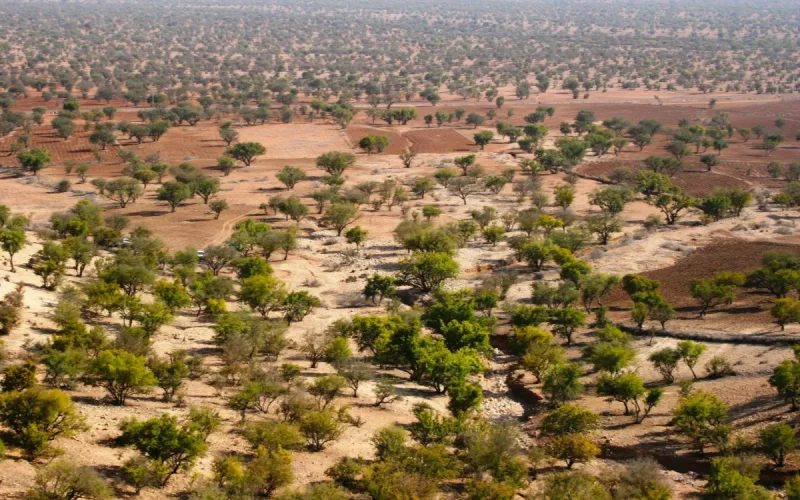
A 25-year study in Essaouira province shows that the argan forest partially stabilized after the decline caused by drought between 2012 and 2016, without returning to its previous trajectory. Coastal areas remain the most vulnerable.
Researchers from Mohammed V University in Rabat analyzed the evolution of landscapes dominated by argan trees throughout Essaouira province between 2000 and 2025. Their work was published on September 9 on Sciforum, ahead of its presentation at the International Electronic Conference on Forests held from September 14 to 16.
The study is based on a natural capital index constructed from twelve biophysical and human indicators. The data, processed by 300-meter zones using Google Earth Engine, make it possible to compare the state of the vegetation, soil temperature and the pressures exerted on the ecosystem.
On Bladi.net : Morocco Launches Massive Reforestation Campaign in Northeast Provinces
The researchers distinguish three periods. The condition of the argan forest gradually improves between 2000 and 2011, before declining under the effect of drought between 2012 and 2016. A partial stabilization then appears, but without a genuine return to the previous situation.
Essaouira’s Coast Falls Behind
This average trend conceals major differences within the province. The gap between the preserved woodlands inland and the degraded coastal areas exceeds 37 points on the index used by the researchers.
Overall, 19.3% of the communes record a statistically significant deterioration of their ecosystem, mainly along the coast. Conversely, an improvement is observed in 40.4% of the communes.
The condition of the vegetation is the main factor explaining these results, with a weight of 35.2% in the model. Summer soil-surface temperature ranks second, at 22.1%, confirming the vulnerability of the argan tree to high temperatures and water shortages.
On Bladi.net : Morocco Launches 100-Hectare Argan Tree Planting Initiative in Tiznit Province
This mapping should make it possible to identify the areas where restoration operations are most urgent. It also provides new insight into the argan tree planting programs that planned 2,885 hectares in Essaouira province.
Related Articles
-

Six stations for 480 million dirhams: the LGV project transforms the Kénitra–Casablanca corridor
17 September 2026
-

“ We do not agree 100% with Israel”: Bourita explains why Morocco maintains its relations
17 September 2026
-

This Rabat neighborhood becomes the second coolest in the world, ahead of Los Angeles and Tokyo
17 September 2026
-
Russia, Iran, Belarus: Hapag-Lloyd imposes a new clause on all its cargo passing through Morocco
17 September 2026
-

Five days to deliver to Morocco a military cable capable of withstanding nearly 1,100 °C
17 September 2026