
They Produce Their Own Electricity in Morocco but Can Sell Only 20 % of It
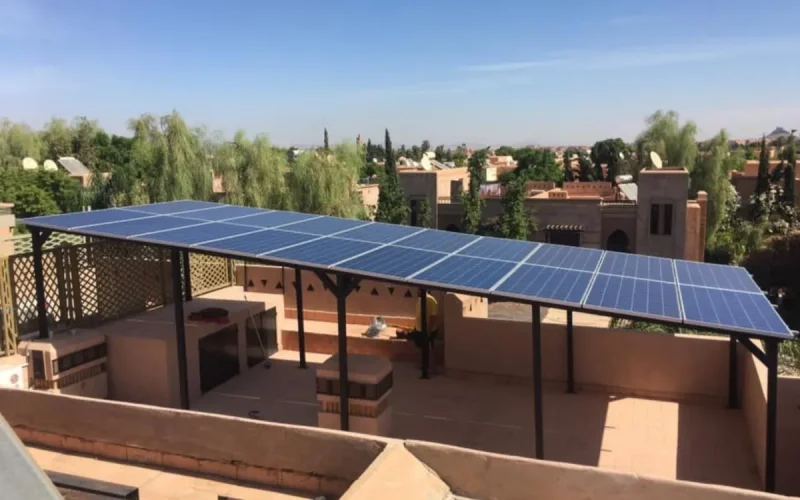
Moroccans who produce their own electricity can sell to the grid only the equivalent of 20 % of their annual production. Greenpeace is calling for the removal of this cap, which it considers unfavorable to households and small solar installations.
In a note published on Tuesday, 15 September, Greenpeace Middle East and North Africa is calling on Morocco to reform Law 82.21 on electricity self-generation to allow individuals, farmers and businesses to sell all of their surplus.
Article 12 of this law currently authorizes a self-generator to transfer to the grid operator a maximum of 20 % of its annual production. This limit does not necessarily concern the amount of electricity fed into the grid, but rather the amount for which its producer can be paid.
Greenpeace believes that the grid can therefore receive electricity financed by a household or a business without having to pay for all the electricity fed into it. The NGO is therefore calling for payment for the entire surplus actually sent to the grid.
On Bladi.net : Electricity consumption is increasing five times faster than production in Morocco
The cap also reduces the economic appeal of solar panels for households whose consumption remains moderate. Households that consume a lot of electricity can directly use a larger share of their production and recoup the cost of their installation more easily. For Greenpeace, the current rule therefore risks reserving the main benefits of self-generation for groups that already have the greatest financial means.
A Tariff Is Still Missing for Small Installations
The NGO points to another obstacle: the absence of a clear purchase tariff for electricity fed into low-voltage grids. Without knowing in advance the price at which their surplus will be bought, households find it difficult to calculate the profitability of their panels or obtain bank financing.
Greenpeace is also calling for the 11 kW threshold to be raised, beyond which connection procedures become more complex. This level is considered too low for apartment buildings, farms equipped with cold-storage rooms or certain small businesses.
The organization also wants to simplify procedures, reduce certain fines and entrust the review of applications to an entity independent of grid operators. The latter are responsible both for connections and may lose part of their sales as self-generation develops.
This intervention comes a few days after the RNI’s promise to allow Moroccan households to produce their own electricity and sell their surplus. Greenpeace is now setting out the conditions necessary for such a system to be viable: removal of the cap, a transparent tariff and simplified connection procedures.
On Bladi.net : Morocco aimed for 52 % renewable energy by 2030, but could reach it as early as 2028
In 2024, renewable energies accounted for 45 % of installed electricity capacity in Morocco, but only around 27 % of the electricity actually produced. The Kingdom is aiming for a share of 52 % of its installed capacity by 2030.
Related Articles
-

Six stations for 480 million dirhams: the LGV project transforms the Kénitra–Casablanca corridor
17 September 2026
-
“ We do not agree 100% with Israel”: Bourita explains why Morocco maintains its relations
17 September 2026
-
This Rabat neighborhood becomes the second coolest in the world, ahead of Los Angeles and Tokyo
17 September 2026
-
Russia, Iran, Belarus: Hapag-Lloyd imposes a new clause on all its cargo passing through Morocco
17 September 2026
-

Five days to deliver to Morocco a military cable capable of withstanding nearly 1,100 °C
17 September 2026