Ancient Beachside Stroll: Dinosaur Footprints Unveil Morocco's Prehistoric Coast
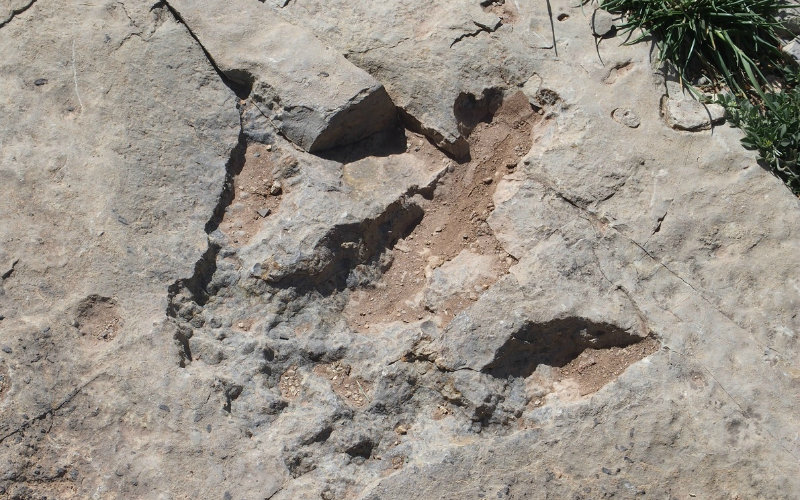
Moroccan researchers were able to confirm the discovery of theropod dinosaur footprints in Taghazout, following field research work carried out after the dissemination of a video by young internet users in September.
"It was young people who spotted these footprints and shared them online. When I saw their post, I went to the site with members of AMORS (Moroccan Association for Scientific Orientation and Research) to verify. Once on the ground, we found that these were indeed dinosaur footprints. It was a very pleasant surprise," says Moussa Masrour, a retired professor of paleontology and biostratigraphy and the scientific director of the Museum of Geology and History of Anza.
According to the explanations he provided to the website Le360, this recent discovery confirms observations already made in the region: the rocks of Taghazout are of the same geological age as those of Anza, where footprints had been discovered before 2014. Their existence dates back between 84 and 85 million years (Santonian). "At that time, there were no mountains yet. The Atlas mountain range did not exist. The coastline then corresponded to a vast beach on which dinosaurs walked and left these traces," the researcher recalls. Before this discovery, there were others made at other sites in southern Morocco. "The growing number of fossil sites confirms the paleontological richness of the Agadir region and its scientific importance," comments Masrour.
Currently, the scientific director of the Museum of Geology and History of Anza and his team are trying to preserve this discovery. To do this, they have opted for molding. This is an essential technique to preserve the memory of the footprints without moving or altering them, a faithful reproduction of the shape of an object or a natural imprint thanks to a flexible material, usually silicone or a special resin, explains the paleontology expert. And he concludes: "The idea is to keep a copy in the Anza museum so that the public can see it, but also to make prints for schools. This allows students to discover these dinosaur traces up close and understand the geological richness of their region."