Discovery in Morocco: a rare ant identified in an isolated region
Moroccan researcher Ahmed Tahiri, professor at the Laboratory of Ecology, Taxonomy and Biodiversity Conservation, Biology Section at the Faculty of Sciences in Tetouan, has discovered a rare species of ant, present only in the Chtouka Aït Baha region, north of Tanalt.
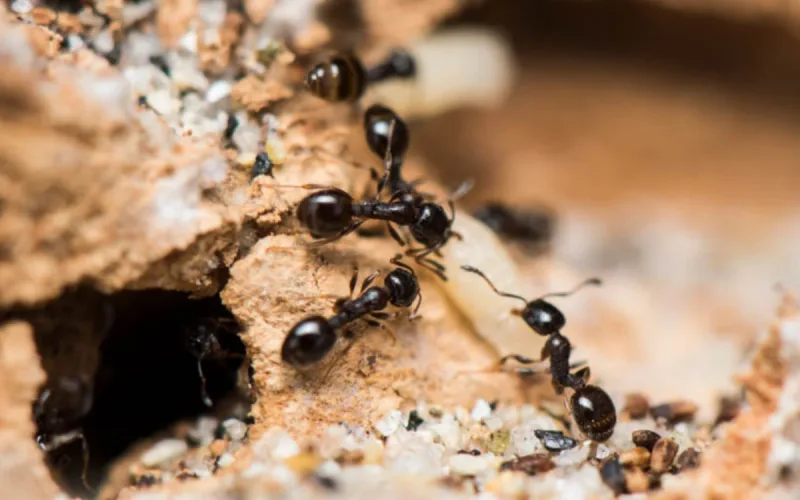
This ant was discovered as part of a very recent study conducted by an international team of researchers, in which Ahmed Tahiri participated. Published in the journal "Insect Systematics and Diversity", the study is based on precise analyses combining morphological studies and advanced genetic examinations. This newly discovered species, Temnothorax lailae or "Laila", belongs to the "Temnothorax rottenbergii group", the study indicates, specifying that it is a "group known for its taxonomic complexity and the difficulty of distinguishing its species due to their great morphological similarity".
The discovered ant species is distinguished "by its dark color, small size and fine patterns on the abdomen, traits that can only be identified through microscopic measurements and precise morphometric analysis", the study emphasizes. In a statement to Hespress, Ahmed Tahiri explained that this species "is characterized by its ability to adapt and live in cold mountainous areas, and it is found only north of Tanalt, in the Chtouka Aït Baha region", estimating that "this confirms the need to preserve national ecosystems".
The study was based on "a large database comprising 527 individuals collected from 170 sites across the Mediterranean basin, subjected to the measurement of 24 precise morphometric traits concerning the head, thorax, abdomen and size", the Moroccan researcher further developed, adding that "the analysis of UCE (ultra-conserved elements) sequences, a modern technique used to reconstruct the evolutionary relationships between species with great precision, was carried out, which made it possible to distinguish closely related species and to correct a number of taxonomic errors that had persisted for decades".
"The work was not limited to the discovery of the new species, but also included a complete taxonomic revision of 20 species within the group, including the redefinition of certain species and the modification of the taxonomic level of others", which "makes this study one of the most important modern scientific revisions dedicated to the Temnothorax genus in the Mediterranean region, supported by high-quality images and clear distribution maps", the scientist affirmed, arguing that this discovery "establishes Morocco’s position as the second basin in terms of biodiversity after Turkey" and "confirms that the Kingdom can occupy the first place in this field if we manage to carry out solid scientific studies".