Morocco: Researchers Discover a Giant 470-Million-Year-Old Marine Scorpion
An international team of Moroccan, French, Canadian and British researchers has discovered a new species of giant marine scorpion in Morocco.
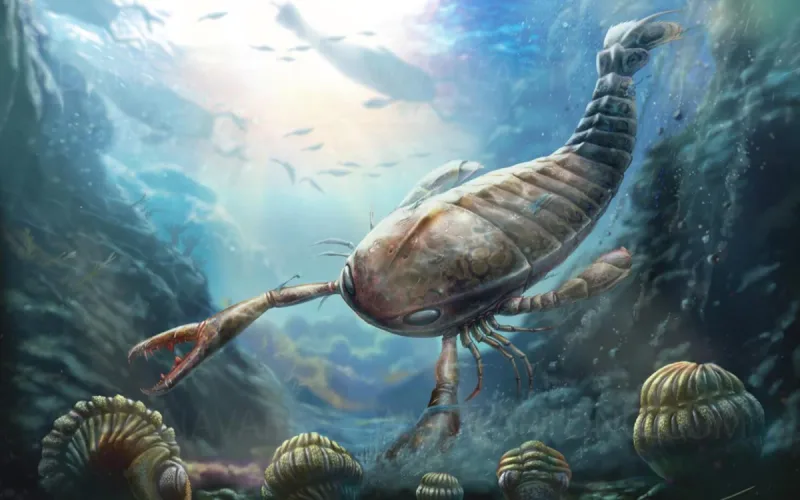
Carcinosoma aurorae. This is the name of the new species of giant marine scorpion discovered in the Paleozoic deposits of southern Morocco, near Zagora, in the Drâa-Tafilalet region, within the sedimentary formations of the Fezouata Biota, famous for the quality of fossilization of soft-bodied organisms, by an international team led by Moroccan paleontologist Abderrazak El Albani, from the University of Poitiers, and Canadian researcher David L. Rudkin, from the Royal Ontario Museum, according to a study published in the journal Proceedings of the Royal Society B. It is a fossil about 470 million years old. It was found in several carefully articulated fragments. The researchers had to proceed with a complete three-dimensional reconstruction.
This exceptional fossil comes from the famous Fezouata Biota, a geological ensemble already known worldwide for the richness of its preservation. What about its morphology? It is both massive and slender: a horseshoe-shaped cephalothorax, powerful front limbs ending in slender pincers, and a long, segmented tail that could have served as a balance or defensive weapon, the researchers report. Carcinosoma aurorae measures nearly two meters long. A size that far exceeds that of known specimens of the same genus, according to the international team.
"We are dealing with one of the largest marine predators of its time," explains David Rudkin. He continues: "Its anatomy testifies to a perfect adaptation to active hunting in shallow environments, where it must have established itself as a formidable hunter." The original coloration of the animal, reconstructed from mineralized residues, should have oscillated between reddish-brown and metallic blue, giving it an iridescent appearance under marine light, the authors of the study specify. Furthermore, the configuration of the locomotor appendages suggests a swimming alternating between propulsion and crawling, comparable to that of modern horseshoe crabs.
For French geologist Laurent Vannier, co-author of the study, this discovery "shows that large predators appeared much earlier than we thought." He adds: "It challenges the idea that complex food webs emerged only in the Silurian or Devonian. Morocco provides evidence that sophisticated trophic interactions already existed in the early Ordovician." For Abderrazak El Albani, the Fezouata Biota "reveals that the diversification of animal forms was not a sudden phenomenon, but a continuous process spanning several tens of millions of years." And to note: "Each new specimen discovered in this region of Morocco provides an additional element to the understanding of the origins of modern major marine ecosystems."