
Morocco drifting towards Europe
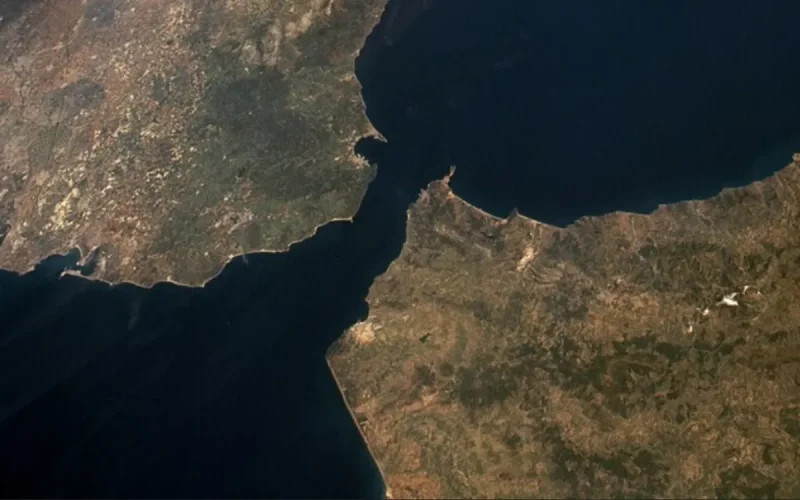
The millimetric rapprochement between the African and Eurasian tectonic plates condemns the Mediterranean Sea to disappear. This slow geological process will inevitably end up welding the African continent to the south of Europe.
The African and Eurasian plates are converging at a measured pace between 4 and 6 millimeters per year. According to data relayed by the scientific platform Science Direct, this continuous compression will eventually lead to the complete closure of the Mediterranean basin. This movement will ultimately result in the fusion of Africa and Europe on the western facade.
On Bladi.net: Europe will have land borders with Morocco
This phenomenon is manifesting itself very precisely between Spain and northern Morocco. The area located under the island of Alborán is gradually drifting westward, reducing the distance between the Betic mountain range and the Moroccan Rif. However, this approach dynamic is not frontal, but oblique. It is this asymmetry of pressure that currently forces the entire Iberian Peninsula and Portugal to undergo a slow rotation.
The complexity of this tilting is explained by the absence of a subduction zone in the western Mediterranean. Instead of sliding one under the other, the plates disperse their compressive forces through the earth’s crust. Researcher Asier Madarieta, director of the study, thus points out that "the boundary between the plates around the Atlantic Ocean and Algeria is very clear, while in the south of the Iberian Peninsula, it is much more blurred and complex".
On Bladi.net: Morocco-Algeria: The security dilemma that threatens to ignite the Mediterranean
To analyze this deformation boundary, scientists used geopositioning sensors, the study of recent earthquakes, and satellite observations. These surveys show that while the Gibraltar arc absorbs the tensions to the east, the collision is directly pushing the peninsula from the southwest. However, the exercise has a margin of uncertainty due to the measurement tools of the 1980s. The director of the study specifies in this regard that "these data only offer a small window on geological evolution".
Related Articles
-
220 dirhams on construction sites, up to 400 in the fields: Morocco lacks workers
25 August 2026
-

This Israeli company equips defense giants and also has clients in Morocco
24 August 2026
-

After three days in Algeria, a sanctioned Russian ship passes near Morocco
24 August 2026
-

In Brussels, a Moroccan name and being over 50: the profile most disadvantaged in hiring
24 August 2026
-

Morocco Has a New Billionaire Forbes Has Yet to Spot
24 August 2026