
The day before 72,000 crossings from Morocco, the CNI had issued a warning: the judge wants to know who knew what
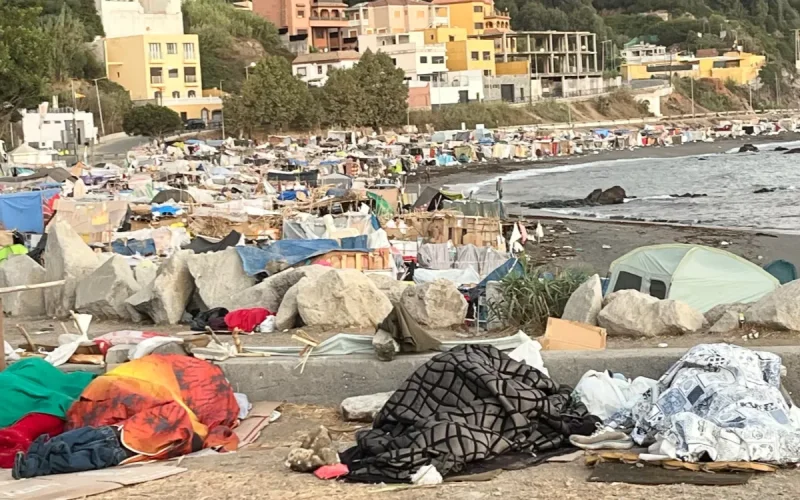
Judge María Tardón wants to determine what became of a Spanish intelligence warning sent the day before the mass crossings into Ceuta. The testimony of a former aide could now put Madrid’s representative in the enclave in difficulty.
The investigation into the events of 30 and 31 July is drawing closer to the Spanish officials responsible for anticipating the crisis. The National Court judge is seeking to establish which services had been warned, who was supposed to intervene and why the warning did not prevent the mass arrival of migrants from Morocco.
The Spanish National Intelligence Centre (CNI) warned as early as 29 July that a call was circulating on social media to cross the border “via the fence and by sea” the following day at 8 p.m. Two groups totalling approximately 180,000 followers were involved, reports El Español.
This warning was received by Gonzalo Sanz, then chief of staff to the Spanish government delegate in Ceuta, Miguel Ángel Pérez Triano. Sanz says he immediately passed it on to his superior. The delegate nevertheless publicly stated that he had not been informed by his aide.
On Bladi.net : Ceuta: Spain prepares its scenarios in the face of a possible “migration weapon”
The contradiction is now at the heart of the investigation. Gonzalo Sanz, who left his position on 11 September, is due to be questioned as a witness on 1 October. He refused to testify by videoconference and wishes to appear in person.
His hearing could determine whether Miguel Ángel Pérez Triano should in turn be summoned. The judge will also hear the president of Ceuta, Juan Jesús Vivas, on 30 September, followed by Sebastián Vega, who headed the local police at the time of the crisis.
Six lines of inquiry examined between Madrid and Rabat
The CNI warning is only one of the six lines of inquiry. María Tardón also wants to know how the calls to travel to Fnideq were launched, who planned and financed the mobilisation, and which people coordinated the journeys.
The investigation concerns the approximately 72,000 crossings from Morocco recorded in Ceuta over two days. According to the police report that prompted the proceedings, the usual migrant-trafficking networks would not have had the means to organise a movement on such a scale on their own.
The magistrate also wants to identify the Moroccan agents appearing in videos and photographs taken in Fnideq. Some are suspected of having directed migrants towards specific points along the border. This involvement remains a hypothesis being examined by the justice system, not an established responsibility.
The forensic police, the judicial police, the National Police intelligence services, the CNI and the National Immigration and Border Centre were tasked with analysing the images.
On Bladi.net : The CNI had identified 2,000 people near Ceuta; 72,000 ultimately crossed the border
To identify the authors of the calls circulated online and their possible connections abroad, requests were also sent to Meta, WhatsApp, Facebook, Instagram, TikTok, Telegram, Google and Apple. The judge is also examining possible irregular transfers of migrants from Ceuta to the mainland after 31 July.
Related Articles
-

The Ceuta crisis causes bookings to plunge by 90 %… but not in Morocco
18 September 2026
-

Spain closes a maritime zone off Morocco to fire live missiles
18 September 2026
-
After the mass arrivals from Morocco, NATO official assures that the Alliance would support Spain
18 September 2026
-
20,000 people in Ceuta and Melilla to make it impossible for Spain to respond militarily
17 September 2026
-
Tarifa–Tangier surges: 18.8% more cars and a rise from 4th to 2nd place
17 September 2026