
Spain rotating toward Morocco: geological discovery explained
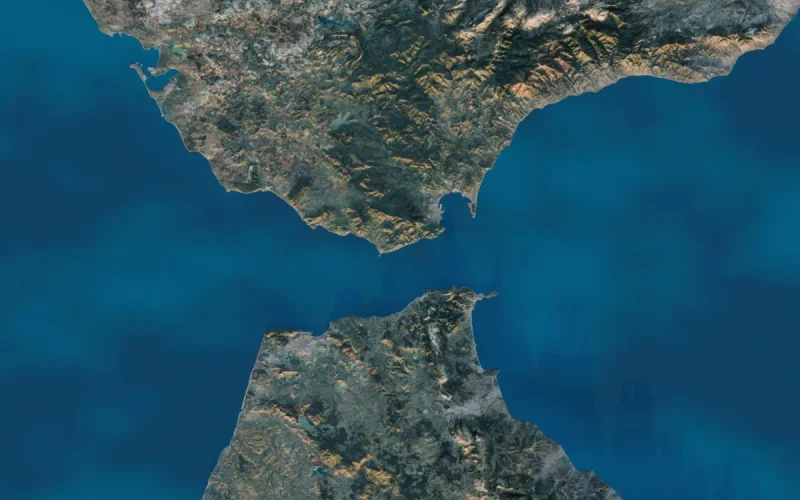
The Iberian Peninsula is undergoing a slow rotation due to the convergence between the African and Eurasian plates. This movement, almost imperceptible on a human timescale, sheds light on the geological dynamics at work between southern Spain and northern Morocco.
Researchers from the universities of the Basque Country, Granada, and Palermo analyzed GNSS satellite data as well as seismic mechanisms recorded in the western Mediterranean. Their work confirms that the Iberian Peninsula is gradually rotating clockwise.
On Bladi.net : Europe will have land borders with Morocco
This rotation is linked to how the stresses caused by the convergence of Africa and Eurasia are distributed around the Strait of Gibraltar. The two plates are currently converging at an estimated speed of between four and six millimeters per year.
East of the strait, part of the deformation is absorbed by the Gibraltar Arc, which connects the Spanish Betic Ranges to the Moroccan Rif. To the west, the collision between Africa and the Iberian part of the Eurasian plate is more direct. This pressure exerted on southwestern Spain would favor the rotation of the entire peninsula.
The study, published in the scientific journal Gondwana Research, primarily allows for better localization of zones where tectonic stresses accumulate and structures likely to cause earthquakes. However, researchers emphasize that available satellite data only covers a few decades, whereas these changes unfold over millions of years, the original study notes.
On Bladi.net : Morocco drifting towards Europe
These results therefore do not mean that Spain will rapidly move toward Moroccan coasts or that it will be attached to Morocco in a hundred million years. Rather, they show that a slow rotational movement is already transforming the zone between the Iberian Peninsula, Gibraltar, and the Rif.
Related Articles
-

8.2 million dirhams for new vehicles tasked with monitoring Moroccan airport runways
18 September 2026
-
2030 World Cup: Fitch warns Morocco that cost overruns could increase its debt
18 September 2026
-

Six stations for 480 million dirhams: the LGV project transforms the Kénitra–Casablanca corridor
17 September 2026
-

“ We do not agree 100% with Israel”: Bourita explains why Morocco maintains its relations
17 September 2026
-
This Rabat neighborhood becomes the second coolest in the world, ahead of Los Angeles and Tokyo
17 September 2026