Rejected at First, Mounia Ezzaher’s Ideas Are Now Reshaping Her Family’s Hotels in Essaouira
A graduate of a prestigious Swiss hospitality school, Mounia Ezzaher returned to Essaouira to modernize her family business. Her first proposals met with strong resistance. Four years later, almost all have been adopted. The young executive recounts her difficult start to the American magazine Forbes.
“I wanted to revolutionize everything all at once, and I got a serious backlash.” Mounia Ezzaher has not forgotten arriving at her family’s hotels in Essaouira at the age of 24. A graduate of the École hôtelière de Lausanne who had worked for the prestigious Mandarin Oriental group, she thought she could quickly transform her parents’ business. She had plenty of ideas, and plenty of enthusiasm. But the reception was harsh. Four years later, however, almost all of her initial proposals have been implemented.
On Bladi.net : She falls in love with her Moroccan surf instructor, and together they turn an abandoned riad into a hotel
The young Moroccan describes the experience in an interview published on October 14 by the American magazine Forbes. She now runs Villa Maroc and Les Jardins de Villa Maroc, two properties owned by her family. Her mistake, she acknowledges, was not having bad ideas, but trying to impose them before understanding how the business worked.
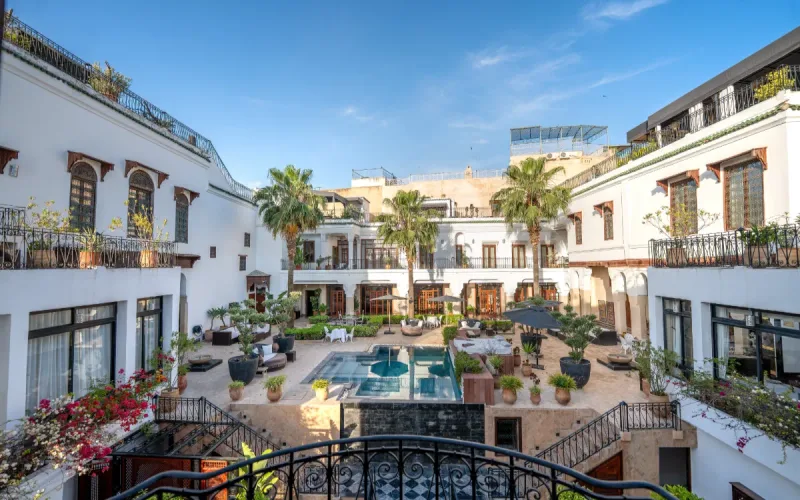
She had, after all, grown up in this world. Her father, Abderrahim Ezzaher, a Moroccan, and her mother, Cornelia Hendry, a Swiss woman, developed Villa Maroc in the 1990s. Set across four 18th-century riads in the heart of Essaouira’s medina, the 21-room boutique hotel was one of the pioneers of high-end tourism in traditional Moroccan homes.
Their daughter’s arrival was meant to usher in a new chapter. But the methods she had learned at leading schools and international establishments were not enough to convince employees who had their own experience in the industry. Mounia says she had to set aside her haste and begin by observing the hotels’ daily operations and listening to the people who worked there.
Four years later, almost all her ideas have been adopted
The change in approach paid off. Without detailing the measures introduced, Mounia tells Forbes that almost all the proposals rejected when she arrived were eventually put into practice. She also acknowledges that for a long time she feared she would not be taken seriously because of her young age. Today, she gives more weight to employees’ experience, especially that of those who have worked in hospitality far longer than she has.
Her approach to luxury also took shape through her interactions with guests. At Mandarin Oriental, she realized that beautiful rooms and flawless service are not enough to create a memorable stay. What matters, she explains, is how visitors are welcomed, recognized and looked after, particularly when a problem arises.
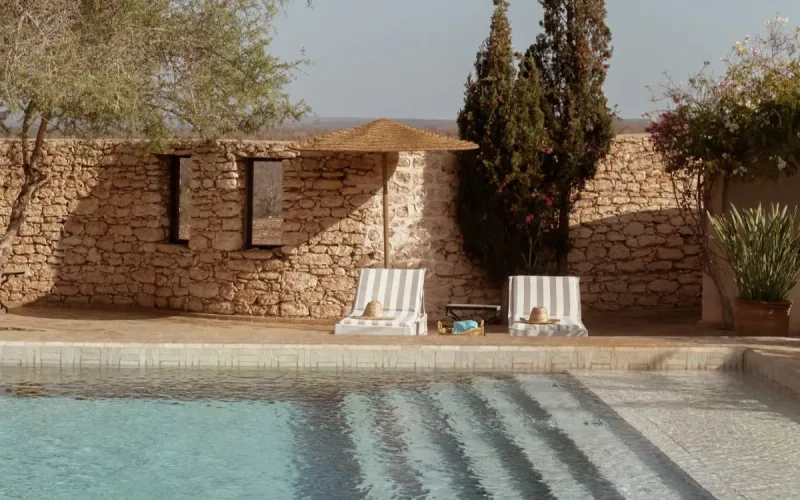
This philosophy is reflected in the two family properties. In an interview with Moralmoda in June 2025, the executive said she wanted to combine Swiss precision with the warmth of Moroccan hospitality. Villa Maroc retains its traditional architecture, zellige tiles and objects made by local artisans, while Les Jardins de Villa Maroc offers eleven eco-domes inspired by homes made of earth in the south of the country.
On Bladi.net : Near Essaouira, this Moroccan hotel is ranked the 8th most beautiful in the world
The second property also focuses on environmental solutions. According to Mounia, 70% of its energy comes from solar power, and its swimming pool is heated using residues from olive oil production. Both hotels prioritize local purchasing, on-site training and relationships built over several decades with Moroccan artisans.
In her account to Forbes, Mounia Ezzaher emphasizes another lesson she has learned over the years: a leader should never consider certain tasks beneath their position. Even at the helm of two luxury hotels, she believes one must be ready to pick up a tray and serve a guest personally when the situation calls for it.