New Jurassic Crocodile Relative Found in Morocco Had Needle-Thin Teeth
A new species of prehistoric crocodile has been identified in the Moroccan Atlas. About 170 million years old, the animal had exceptionally slender teeth, with no known equivalent among its close relatives. The discovery involved Moroccan and British researchers.
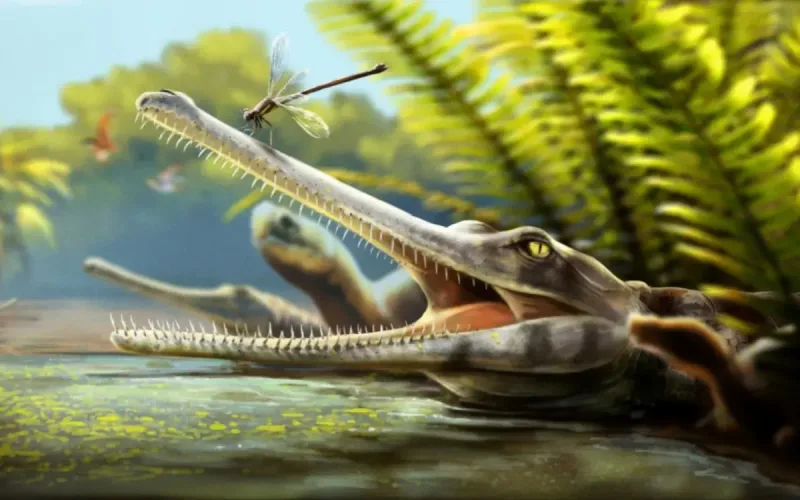
It lived in the waters of what is now Morocco 170 million years ago. Researchers from the University of Portsmouth in the United Kingdom and Hassan II University of Casablanca have identified a new prehistoric relative of crocodiles. Named Ctenosuchus tenuidens, this Jurassic animal had a particularly remarkable jaw lined with long, needle-thin teeth. The discovery was announced this Monday, October 12, by the British University of Portsmouth.
The fossils come from the Talsint–Anoual region, in Figuig province, in the heart of the eastern High Atlas. Scientists studied two incomplete specimens, including fragments of jaws and teeth. These remains belong to a group of reptiles related to crocodiles, the thalattosuchians, which inhabited aquatic environments during the age of the dinosaurs.
The discovery of the teeth surprised the researchers. While examining one of the fossils, Hamzah Imran, the study’s lead author, noticed tiny black circles on a bone. He and his team placed the fragment under a microscope before carefully uncovering one of the marks with a scalpel. The more rock they removed, the longer the structure became. The mysterious spots were actually exceptionally slender teeth.
Such fragile teeth reveal a surprising diet
The study published in the Journal of Vertebrate Paleontology on October 8 describes a unique set of teeth. The teeth were about ten times taller than they were wide, with an average spacing of just 2.3 millimeters. The researchers estimate that the animal had more than 35 teeth on each side of its upper jaw.
Such teeth probably would not have allowed it to catch large prey. They might have broken under the force of a powerful fish’s movements. The scientists therefore favor a diet of small fish, crustaceans, worms and other soft-bodied aquatic organisms. The jaw may have worked like a trap, holding these small prey.
On Bladi.net : In Morocco, a discovery 168 million years old surprises scientists
The name Ctenosuchus tenuidens directly refers to this distinctive feature. “Cteno” evokes a comb, “suchus” means crocodile, and “tenuidens” means “fine teeth.” Using electron microscopy, the researchers also found tiny grooves on the teeth, confirming their specialization.
This research, involving Samir Zouhri of Hassan II University of Casablanca, adds to knowledge about the prehistoric crocodiles of Gondwana, the ancient supercontinent that included Africa. In particular, it reveals that ancient Moroccan lakes and waterways were home to crocodile species with feeding habits very different from those of their living descendants.