
Morocco’s mysterious red patch visible from space reveals thriving desert agriculture
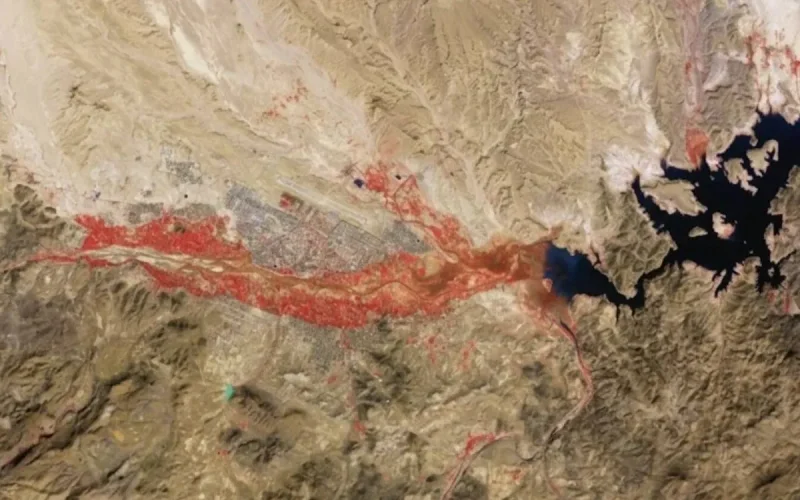
A European satellite captured an immense red coloration extending across the arid zones of Ouarzazate. Far from being an ecological catastrophe, this visual anomaly actually reveals the vitality of a surprising agricultural orchard in the middle of the desert.
The Copernicus Sentinel-2 orbital fleet of the European Space Agency immortalized this chromatic curiosity. Scientists used the near-infrared channel, a technological tool measuring vegetation density. Since healthy plants absorb red light and strongly reflect green and infrared radiation, crops appear as brilliant scarlet on spatial data.
On Bladi.net : Satellites Aid Rescue Efforts in Morocco Earthquake Aftermath
This vivid red blanket unfolds along the watercourses of the Anti-Atlas, an area nonetheless subjected to the extreme aridity of the Sahara. The satellite’s passage coincided with the humid winter season. Thanks to this water supply, secondary streams and surrounding small orchards experienced a biological awakening captured at a fine resolution of 10 meters by optical sensors.
Just north of this oasis lies Ouarzazate, a city world-famous for its desert vines that served as a backdrop for films like Gladiator, Lawrence of Arabia, The Mummy, and the series Game of Thrones. Spatial imagery also reveals the El Mansour Eddahbi dam, recognizable by its opaque black hue. This artificial lake with an average depth of 30 meters stores the waters of the Draa, the longest watercourse in the country, to irrigate the region.
On Bladi.net : Morocco: The Unfinished Promise of Solar Energy
Approximately 10 kilometers further north, the satellite spotted the gigantic Noor concentrated solar power plant. Extending over more than 3,000 hectares, this energy complex stands as the largest concentrated solar energy installation on the planet. Its thousands of curved mirrors direct radiation toward thermal receivers to efficiently accumulate heat.
Related Articles
-

Michelin distinguishes 31 hotels in Morocco, just one behind the African leader
18 September 2026
-
Tomatoes and mandarins drive Moroccan agricultural exports to 2.38 million tonnes
18 September 2026
-

A Fez riad earns a Michelin Key and joins the world’s best hotels
18 September 2026
-

MRE: this mistake when buying in Morocco can block the repatriation of your money
18 September 2026
-
One ship every five minutes between Morocco and Spain: Rabat seeks new rules for straits
18 September 2026