
Moroccan World Cup supporter sparks Spanish media controversy
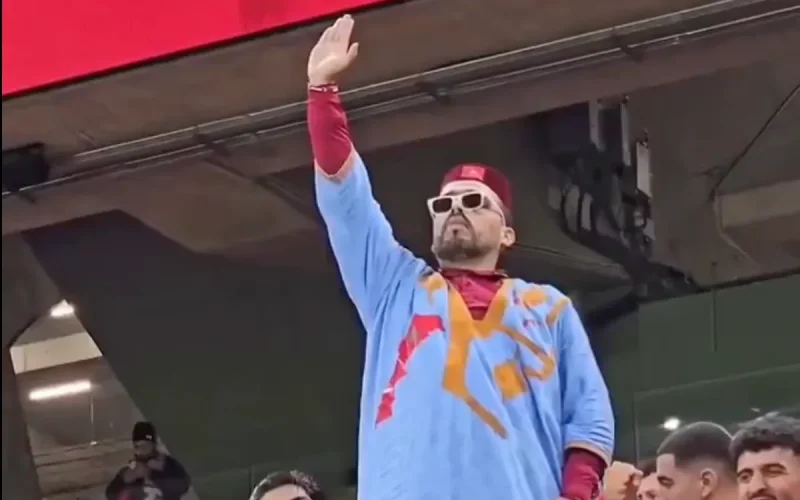
A Moroccan supporter caught the attention of the Spanish press during the match against the Netherlands. His outfit, his gesture in the stands and the map of Morocco he was wearing were interpreted as a political message by a Spanish media outlet.
Morocco’s journey at the 2026 World Cup is not only making headlines on the pitch. In Spain, some media outlets are also scrutinizing what happens in the stands, down to the clothing and symbols displayed by Moroccan supporters.
On Bladi.net : Algerian supporter arrested in Morocco: what we know about his transfer to Rabat
A Spanish article thus focused on a supporter spotted during the Morocco–Netherlands match. The man, dressed in traditional attire and wearing a fez, was filmed imitating the famous gesture of a Congolese supporter nicknamed Lumumba Vea, in reference to Patrice Lumumba, a figure of Congolese independence.
But it was not only the gesture that caught the Spanish media’s attention. The Moroccan supporter was also carrying a map of Morocco that included the Sahara. For the newspaper, this image goes beyond simple stadium folklore and fits into a political reading of the World Cup.
The Spanish article notably criticizes the supporter for having combined a gesture presented as anticolonial with an outfit that the media links to Sahrawi culture. A very political interpretation, which illustrates how certain Moroccan symbols continue to provoke highly hostile reactions in Spain.
Morocco observed beyond the pitch
The same article then broadens its analysis to other sensitive issues between Rabat and Madrid. It notably returns to a sequence attributed to Moroccan goalkeeper Munir Mohamedi, born in Melilla, in which he allegedly said that Ceuta and Melilla "are Moroccan" while joking with his teammates.
The Spanish media sees this as a sign that these questions remain present, even in a context of improved relations between Spain and Morocco. It also recalls the debates surrounding the 2030 World Cup, jointly organized by Morocco, Spain and Portugal.
The question of which stadium will host the final is also mentioned. Spain hopes to see the Santiago Bernabéu chosen, while Morocco highlights the future Hassan II grand stadium, presented as one of the most ambitious projects in world football.
The article finally mentions the map of Morocco included in the 2030 World Cup bid file. Again, the Spanish media sees this as a political symbol rather than a simple graphic detail.
On Bladi.net : Slave of Qatar": Nasser Zefzafi’s scathing response to Khadija Benguenna
This reaction above all shows that Morocco, at the World Cup, is now observed far beyond its sporting results. A gesture in the stands, a map on a piece of clothing, a phrase in the locker room or a stadium under construction can be enough to reignite debates in Spain that go well beyond football. But in Morocco, they are used to this media outlet.
https://x.com/Cleverlydey4u/status/2071826307344945452
Related Articles
-

A Fez riad earns a Michelin Key and joins the world’s best hotels
18 September 2026
-

MRE: this mistake when buying in Morocco can block the repatriation of your money
18 September 2026
-
One ship every five minutes between Morocco and Spain: Rabat seeks new rules for straits
18 September 2026
-

8.2 million dirhams for new vehicles tasked with monitoring Moroccan airport runways
18 September 2026
-

2030 World Cup: Fitch warns Morocco that cost overruns could increase its debt
18 September 2026