
$10.8 billion: a study outlines a 900-kilometre pipeline between Tan-Tan and Mohammedia
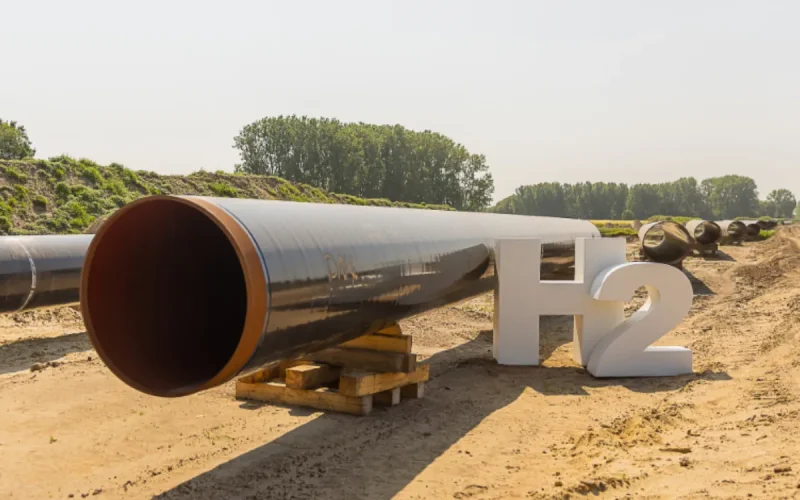
Moroccan researchers have modelled a national corridor for green hydrogen. Their most economical scenario combines a 900-kilometre pipeline between Tan-Tan and Mohammedia with coastal maritime transport to Jorf Lasfar and Tanger Med.
The study was published on September 4 in the scientific journal Hydrogen. Its authors, affiliated with higher education institutions in Fès and Meknès, sought to determine how green hydrogen and ammonia could be produced, stored and transported in Morocco by 2030, 2040 and 2050.
Their model includes four hubs: Tan-Tan, Mohammedia, Jorf Lasfar and Tanger Med. It compares different combinations of pipelines and cabotage, meaning maritime transport between Moroccan ports, in order to identify the configuration with the lowest overall cost.
The resulting solution is based on a 900-kilometre main pipeline between Tan-Tan and Mohammedia, supplemented by maritime links for the other branches of the corridor. However, this is not a project announced by the Moroccan government or the definitive route of a future infrastructure project, but the result of economic and logistical modelling.
On Bladi.net : Morocco positions itself as a future hub of clean energy to Europe
The researchers estimate the discounted cost of the entire chain studied at $10.838 billion. Relative to the volumes of ammonia delivered during the period under consideration, the cost comes to $1,176 per tonne, or approximately €1,089.
This hybrid scenario would be slightly cheaper than a network made up solely of pipelines, whose cost would reach $1,186 per tonne. The gap becomes greater compared with a solution relying entirely on maritime transport, estimated at $1,233 per tonne.
Storage makes the pipeline more attractive
The choice of the pipeline between Tan-Tan and Mohammedia is not explained solely by transport costs. According to the study, the volumes transported along this route would not, on their own, be sufficient to amortise the construction of the pipeline. Freight savings would cover only 26% of its investment cost.
Its main advantage would be to provide access to a less expensive underground storage solution. The model attributes savings of approximately $790 million over the entire period to this possibility.
This result nevertheless rests on several technical assumptions, including the existence of a maximum capacity of three million tonnes in salt caverns. The authors acknowledge that this geological capacity still needs to be confirmed by field studies. The cost of the pipeline, set at $1.5 million per kilometre, is also a calculation assumption.
For the less frequently used branches, maritime transport remains more profitable. Converting them into pipelines would require approximately $570 million in additional investment, while their utilisation rate would remain below 36%.
The researchers also tested the corridor’s operation in a digital twin. This simulation concluded that the pipeline could absorb the selected peak flows and that switching from continuous pipeline transport to periodic ship loading would not cause critical congestion in the modelled ports.
On Bladi.net : €18 billion announced: OCP and Engie significantly scale back their mega-project
Renewable electricity accounts for 43.4% of the total cost, ahead of electrolysers at 29.7% and ammonia production at 15.3%. The scenario notably assumes a particularly high capacity factor of 50% for Tan-Tan’s renewable installations.
The study thus provides a first quantified blueprint for a possible Moroccan hydrogen network. Above all, it shows that a 900-kilometre pipeline could become economically viable if associated with storage, while smaller volumes would continue to be transported by sea. Its implementation would nevertheless depend on geological validations, industrial investment and public decisions that have not yet been announced.
Related Articles
-

Six stations for 480 million dirhams: the LGV project transforms the Kénitra–Casablanca corridor
17 September 2026
-

“ We do not agree 100% with Israel”: Bourita explains why Morocco maintains its relations
17 September 2026
-

This Rabat neighborhood becomes the second coolest in the world, ahead of Los Angeles and Tokyo
17 September 2026
-
Russia, Iran, Belarus: Hapag-Lloyd imposes a new clause on all its cargo passing through Morocco
17 September 2026
-

Five days to deliver to Morocco a military cable capable of withstanding nearly 1,100 °C
17 September 2026