Tanger Med, Spain’s Obsession
Tanger Med was not yet open when the Spanish press was already worried about its consequences. Twenty-three years later, the Moroccan port has overtaken Algeciras and its name continues to be associated in Spain with the same words: rival, competition, threat.
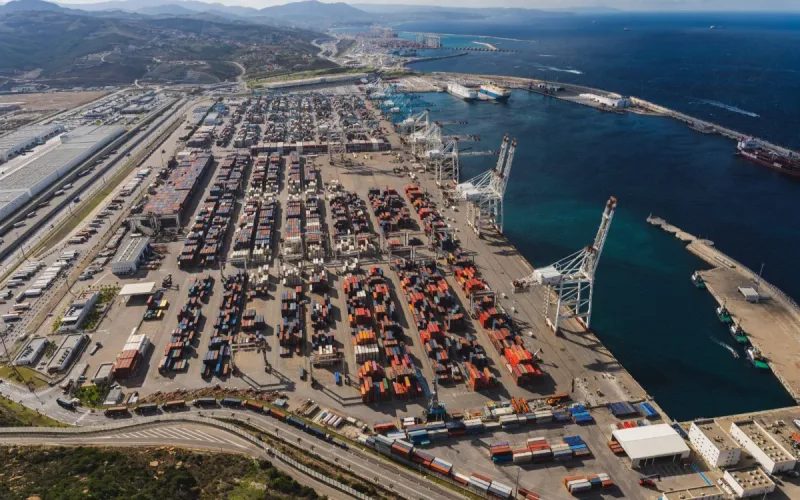
It is August 2003. Tanger Med exists only on paper. Yet El País has already devoted an article to it with a revealing headline: “The Rivalry Moves to the Ports.” The future Moroccan complex, then announced for 2006, is presented as “a threat to Ceuta” capable of becoming “a rival to Algeciras.”
On Bladi.net : Maersk Abandons Algeciras: Geopolitical Tensions and EU Emissions Rules Reshape Mediterranean Shipping
Five years later, when the project becomes a reality, the Spanish daily changes its vocabulary but not really its perspective. In 2008, it describes Tanger Med as a “monster,” a macro-port forcing Algeciras to invest in order to preserve its competitiveness and market share in Mediterranean traffic.
Then the figures begin to give substance to the concerns. In 2013, Tanger Med’s container traffic jumps by 40%. The following year, El País chooses a new formula: “Tanger is targeting Algeciras.” The Spanish port is still the leader in the Mediterranean at that point, but the newspaper already explains that its Moroccan neighbor aspires to “snatch” that position from it.
The story could have ended as a conventional rivalry between two ports a few dozen kilometers apart. Instead, it is going to become a Spanish serial.
In 2017, the Cadiz press warns that Tanger Med is going to triple its capacity to reach nine million containers and far exceed that of its “main competitor,” Algeciras. In 2020, the Campo de Gibraltar Chamber of Commerce warns of a risk that traffic could be diverted toward Morocco. In 2022, El Español goes so far as to speak of a “red alert”: a study commissioned by the Spanish port estimates that Algeciras could lose up to 60% of certain transshipment traffic if the new European emissions rules favor Tanger Med.
With Every Moroccan Record, Algeciras Returns
In 2020, a symbolic turning point is reached: Tanger Med overtakes Algeciras in container traffic. Then the gap widens.
In January 2024, Europa Sur notes that the Moroccan port has also overtaken Algeciras in total traffic: 122 million tonnes in 2023 compared with 104.7 million on the Spanish side, and 8.6 million containers compared with 4.73 million. At the same time, the port companies of Algeciras warn of their “stagnation” compared with Valencia and Tanger Med.
La Vanguardia then devotes an entire article to the face-off between “Tanger and Algeciras.” A few days earlier, the newspaper had already observed that the Red Sea crisis was benefiting Morocco and presented Tanger Med as “the rising port,” now the leading port in the Mediterranean for containers ahead of Algeciras, Valencia and Barcelona.
In 2025, the scenario is repeated after the transfer of several calls by international shipping companies to Morocco. El Español presents Tanger Med as “the major rival of the ports of Valencia, Algeciras and Barcelona,” following Maersk’s decision to remove Algeciras from one of its routes in favor of the Moroccan port.
But the 2025 figures change the scale of the duel. Tanger Med ends the year with 11.1 million containers and 161 million tonnes of goods. Algeciras, for its part, closes the year with around 4.74 million containers. In February 2026, Europa Sur is therefore no longer speaking merely of a competitor drawing closer: “Tanger Med doubles the container traffic of the port of Algeciras and is hot on the heels of Rotterdam and Antwerp.”
The evolution is spectacular. In 2003, the Spanish press wondered whether the Moroccan port still under construction might one day become Algeciras’s rival. In 2026, it is now comparing Tanger Med with the two giants of northern Europe.
And the subject remains extremely sensitive in Spain. On August 11, 2026, in a column devoted to Moroccan geopolitics, La Vanguardia once again returns to Tanger Med, which will be joined by Nador West Med. The author believes that the two ports “cast a shadow over the future” of Spanish ports and goes so far as to mention their ability to economically “strangle” Ceuta and Melilla. This time it is an opinion piece, not a news article, but the vocabulary shows how far the subject can now be pushed in the Spanish debate.
Yet not everything is portrayed as a port war. Some media outlets also emphasize the complementarity between the two shores. El País had already written in 2015 that Tanger Med and Algeciras were certainly rivals, but that together they formed a particularly powerful unit on global routes. The two ports also cooperate on Strait connections.
What remains is a remarkable editorial continuity. For more than twenty years, as Tanger Med grew, the same questions returned in the Spanish press: what will Algeciras lose? Where will the shipping companies go? Is Europe unintentionally favoring Morocco? How should Spain respond?
In 2003, Tanger Med was a possible threat. In 2014, it was “targeting” Algeciras. In 2021, it was “hot on its heels.” In 2025, it had become its “major rival.” And in 2026, it handles more than twice as many containers.
On Bladi.net : Tanger Med Port: Morocco Challenges Rotterdam and Antwerp in Container Traffic
The Spanish obsession ultimately grew at almost the same pace as the Moroccan port.