Morocco: up to 92% of the Sun will disappear just before nightfall
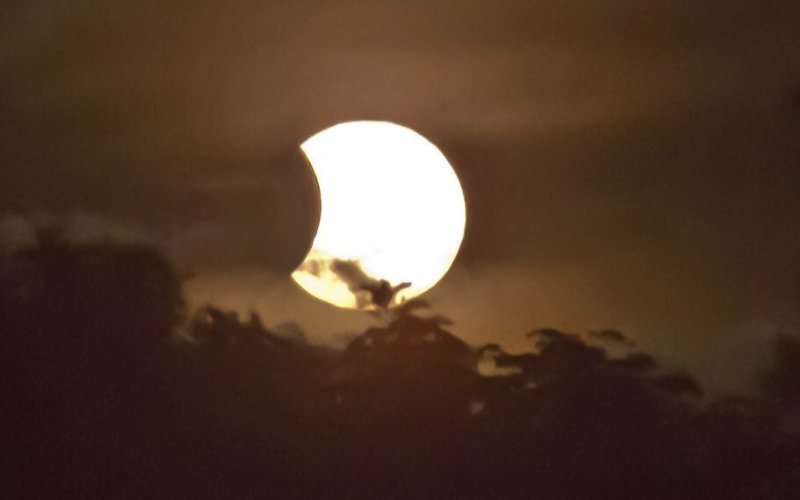
Morocco will witness a major solar eclipse on Wednesday, August 12. The phenomenon will peak shortly before 8 p.m., after which the Sun will disappear below the horizon while the Moon still hides part of it.

The Moon will begin to pass in front of the Sun early in the evening. The spectacle will be visible throughout Morocco, but it will be more impressive in the north of the country, which is closer to the path of the total eclipse.
On Bladi.net : Partial Solar Eclipse to Sweep Across Northern Hemisphere, Starting in Morocco
This eclipse will be total in Greenland, Iceland, northern Spain and a small part of Portugal. Morocco will remain outside the path of totality: the Sun will therefore never disappear completely there.
NASA nevertheless lists northwestern Africa among the regions where the Moon will hide a large part of the solar disk. It particularly highlights a specific configuration: the Sun will set before the eclipse ends, offering the unusual image of a solar crescent descending toward the horizon.
In Tangier, the phenomenon will begin around 6:44 p.m. It will reach its maximum around 7:40 p.m., when nearly 92% of the Sun’s surface will be obscured.
In Rabat, the eclipse will begin around 6:47 p.m. and peak at 7:43 p.m., with approximately 88% of the Sun hidden. In Casablanca, it will begin around 6:48 p.m. and will also reach its maximum around 7:43 p.m., with an obscuration rate close to 87%.
Fez will see nearly 90% of the Sun disappear. The phenomenon will be slightly less pronounced in the south: approximately 83% in Marrakesh and 79% in Agadir. Residents should choose a location offering an unobstructed view toward the west, as the Sun will already be very low in the sky at the time of maximum eclipse.
Sunglasses are not enough
In Casablanca, the Sun will set around 8:20 p.m. while the eclipse is still in progress. The situation will be similar in several other Moroccan cities: the astronomical end of the phenomenon will not be observable, since the celestial body will already have disappeared below the horizon.
The eclipse will remain partial throughout its duration in Morocco. There will therefore be no moment when it is possible to look directly at the Sun without protection.
NASA reminds people that ordinary sunglasses, even very dark ones, do not protect the eyes. Special eclipse glasses complying with the international ISO 12312-2 standard must be used.
On Bladi.net : Ramadan 2026: Experts Reveal Forecasts for the Start of Fasting
Binoculars, telescopes and cameras must also be equipped with a suitable solar filter placed in front of the lens. Looking at the Sun through an unprotected instrument can cause serious eye injuries, even within a few seconds.