
Faced with Morocco’s rise in the Sahel, Algeria now takes its fighter jets beyond its borders
Algeria has just deployed four Su-30 fighter jets to Niger, breaking with its traditional military restraint outside its borders. This new posture comes as Algiers seeks to regain influence lost in the Sahel, particularly in the face of Morocco’s advance.
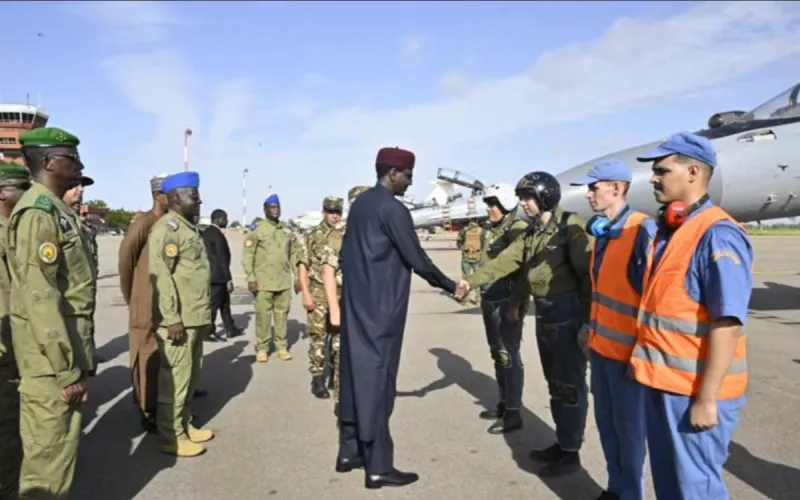
Four Algerian Sukhoi Su-30 fighter jets left the national territory for Niamey. They were accompanied by an Ilyushin Il-76 military transport aircraft and an Il-78 tanker, in what now appears to be an important turning point in Algerian military doctrine.
The deployment took place on Sunday, August 30, the day after an attempt to destabilize the Nigerien regime. In its official statement, the Algerian Ministry of Defense explains that the four Su-30s were sent at the request of the Niamey authorities for a “support mission” to the Nigerien army.
The aircraft ultimately did not take part in the fighting. When the Algerian fighters arrived, the mutinous soldiers had already been defeated. But the highly visible nature of the deployment and the communication organized around their arrival give the operation a significance that goes far beyond one-off military assistance.
The Nigerien Press Agency thus reports that General Abdourahamane Tiani praised a “historic decision” by Abdelmadjid Tebboune and the “exceptional deployment” of the Algerian aircraft to Niamey.
On Bladi.net : article 120927
For Algiers, the main objective is to show that its army can now intervene directly beyond its borders when it considers its regional interests to be threatened.
This development comes at a time when Morocco is gaining ground against Algeria in the Sahel, particularly in Mali.
Algiers wants to regain a foothold in the Sahel
In an analysis published Wednesday, Le Monde believes that this operation marks a genuine paradigm shift for Algeria.
The daily newspaper recalls that Algiers is seeking to restore influence that has greatly eroded in this region. Relations with Mali have become particularly difficult and, in April 2025, Bamako, Niamey and Ouagadougou had even recalled their ambassadors from Algeria after the destruction of a Malian drone by the Algerian army.
At the same time, Rabat has multiplied its overtures to the Sahelian countries. Military cooperation is one component: Malian soldiers have notably been trained in Morocco. Rabat is also developing its initiative enabling landlocked Sahel countries to gain access to the Atlantic Ocean.
According to Le Monde, while Morocco was taking advantage of the difficulties encountered by Algeria to strengthen its influence, particularly in Mali, Algiers now needed to regain a foothold in the region. Niger is the most accessible partner for it within the Alliance of Sahel States.
The stakes go beyond the military issue alone.
Algeria is relying in particular on the trans-Saharan gas pipeline project intended to connect Nigeria to its territory via Niger. This project is directly challenged by the Atlantic Africa gas pipeline backed by Morocco and Nigeria.
Niger’s stability is therefore strategic for Algiers. Security expert Akram Kharief even told Le Monde that this gas-related issue probably weighed in Algeria’s decision to quickly support the Niamey authorities after the attempt at destabilization.
On Bladi.net : article 119530
This military demonstration nevertheless raises another question in Algeria: that of compliance with the Constitution.
The 2020 constitutional revision had specifically opened the way to foreign interventions, legally breaking with several decades of non-intervention doctrine. Article 91 allows the president to decide to send units of the People’s National Army abroad, but only after approval by a two-thirds majority in each of the two chambers of Parliament.
Yet, according to Le Monde, Algerian lawmakers were not consulted before the Su-30s were sent to Niger. Subsequent approval nevertheless remains possible.
The operation therefore constitutes a signal on several levels. In Niamey, it shows that Algiers is ready to defend its new partners. Across the Sahel, it reflects the desire to recover some of the ground lost in recent years. And vis-à-vis Morocco, it above all reveals that the rivalry for influence between the two neighbors is no longer played out solely on the diplomatic and economic fronts: Algiers is now prepared to place its military capabilities directly on the scales.