Morocco Had a Major Industrial Project with Israel and the United States: Four Years Later, It Is Still Missing
In 2022, Morocco and Israel announced the creation of special industrial zones intended to give concrete form to their cooperation with the United States. Four years later, no Moroccan zone is included in the corresponding official U.S. framework.
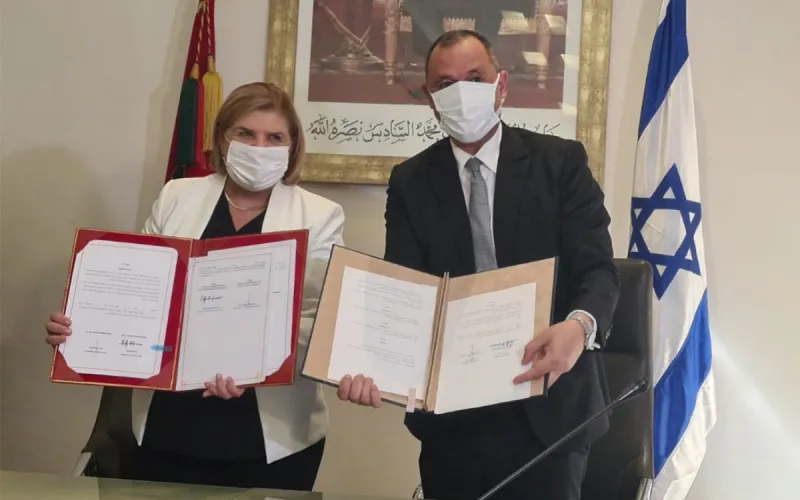
The project was presented on February 21, 2022, in Rabat by Ryad Mezzour, Minister of Industry and Trade, and his Israeli counterpart Orna Barbivai. The two ministers had just signed an economic cooperation agreement intended to give an industrial dimension to the resumption of relations between the two countries.
On Bladi.net : Morocco US Military Center 2030 Drones Innovation Tan-Tan
In its official statement, Morocco’s Ministry explicitly announced the creation of “Qualifying Industrial Zones” (QIZs) in Morocco. The objective was to give concrete form to tripartite Morocco-Israel-United States cooperation and facilitate access to the U.S. market for goods manufactured in these zones.
Bladi.net had also reported on the project a few weeks later. Automotive, aeronautics, agri-food, textiles, the pharmaceutical industry, water technologies and renewable energy were among the sectors identified for this new cooperation.
Washington still has no QIZs in Morocco
Four years later, the project stands out mainly because of its absence from the U.S. framework. The official list of Qualifying Industrial Zones of the U.S. Department of Commerce does not mention any zone in Morocco. Washington currently indicates that the QIZ program allows Egypt and Jordan to export certain products to the United States under preferential conditions when they incorporate Israeli components. The officially recognized zones are located in Egypt, Jordan, the West Bank and Gaza.
The fact sheet devoted to Israel’s trade agreements, updated by the U.S. administration in March 2026, leads to the same conclusion: the QIZs linking Israel with its neighbors are still those established with Jordan and Egypt. Morocco does not appear there.
This does not make it possible to assert that Rabat and Tel Aviv have officially abandoned the project. However, no Moroccan QIZ has been incorporated into the U.S. program four years after Rabat’s announcement. The designation of these zones falls precisely under the authority of the United States Trade Representative (USTR), in coordination with the other federal administrations.
The Moroccan case is all the more unusual because the Kingdom has had its own free-trade agreement with the United States since 2006. The 2022 project was therefore meant to go beyond simple access to the U.S. market: it aimed to create an industrial mechanism directly associating Moroccan and Israeli companies around production intended in particular for the United States. The Morocco–United States free-trade agreement, for its part, remains in force.
On Bladi.net : Morocco imports its wheat, but Israel is counting on it in an emergency
Four years after Rabat’s highly ambitious announcement, trade cooperation between Morocco and Israel has progressed, but this emblematic component of the three-way industrial partnership with Washington remains absent from the official U.S. map.