
Three Firms, 160,000 Dollars a Month: Morocco’s Influence Machine in Washington
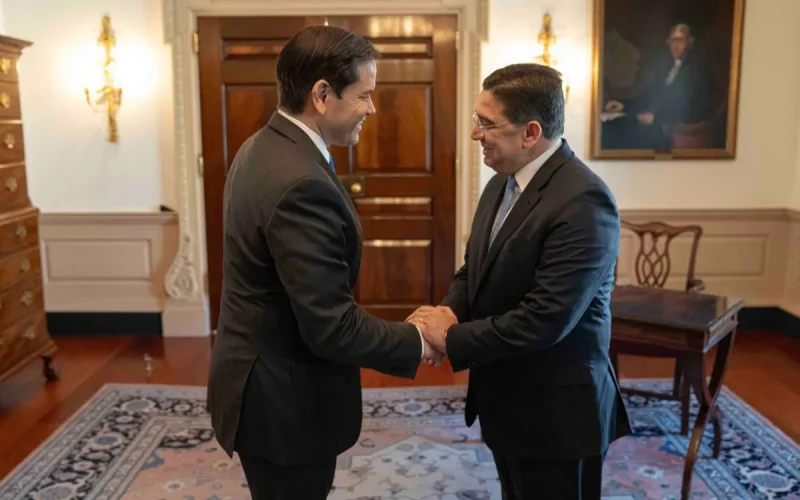
Morocco is no longer relying on a single intermediary to defend its interests in the United States. Three American firms now work simultaneously for Rabat, at a combined cost of 160,000 dollars per month, with missions ranging from Congress to digital communications.
Brownstein Hyatt Farber Schreck, Scribe Strategies & Advisors and Qorvis Communications now form Morocco’s Washington operation. The first receives 65,000 dollars per month, the second 60,000 dollars and the third 35,000 dollars. Maintained for twelve months, this spending rate represents 1.92 million dollars.
Brownstein holds the largest contract. The declaration filed with the US Department of Justice states that a one-year agreement was concluded on March 13, 2026, with the Moroccan embassy. The firm is to provide government relations and public affairs services in order to strengthen Rabat’s ties with the administration and elected US officials.
The case was not entrusted to an unknown entity. The team is notably supervised by Ed Royce, a former member of Congress and former chairman of the House Foreign Affairs Committee. Brownstein thus offers Morocco direct access to officials who know Washington’s decision-making channels perfectly.
The first steps began just a few days after the contract was signed. Documents published in the US register mention discussions with Republican Senator Ted Cruz’s team regarding a text concerning the Polisario Front. Emails and calls were made to organize a discussion and obtain a copy of the draft.
On Bladi.net : article 123080
The second pillar of the operation is Scribe Strategies & Advisors. Its contract with Morocco’s Ministry of Foreign Affairs began on July 28, 2025, for an initial six-month period, automatically renewable. Rabat paid it 75,000 dollars per month during the first three months, before reducing that remuneration to 60,000 dollars.
Scribe is responsible for advising Morocco on its relations with the US government and on the evolution of the partnership between the two countries. Its missions include analyzing public policies, defending Moroccan positions and mobilizing contacts likely to carry weight in the debates.
Congress, opinion networks and digital communications
Qorvis Communications completes this architecture on the media front. Entering into force on August 6, 2026, its contract provides for remuneration of 35,000 dollars per month for six months, with the possibility of an extension. According to O’Dwyer’s, the firm must develop Rabat’s messages, amplify their digital distribution, mobilize influential figures, organize events and manage sensitive issues.
This contract, already detailed by Bladi.net, gives Morocco an intervention capacity that goes beyond institutional contacts. Qorvis can work on how Moroccan positions are presented in the media, picked up on social networks and relayed to American decision-makers.
The three firms therefore do not perform the same function. Brownstein opens the doors of Congress and the federal administration. Scribe monitors political issues and builds the arguments. Qorvis shapes public communications and seeks out the channels capable of imposing them in the American debate.
Their activities appear in the FARA register, the federal system requiring representatives of foreign interests to declare their contracts, remuneration and certain political activities. These documents make it possible to concretely measure the resources committed to Morocco’s influence campaign in Washington.
On Bladi.net : Influence War in Washington: Morocco Spends 10 Times More Than Spain to Win Over America
The Sahara remains at the center of this mobilization. Brownstein’s discussions around a text concerning the Polisario provide a direct illustration, while Qorvis highlights American recognition of Moroccan sovereignty and the autonomy plan defended by Rabat.
With 160,000 dollars spent each month, Morocco is no longer merely reacting when its issues reach Congress or the US administration. It is financing a permanent presence capable of intervening at every stage: among elected officials, in expert circles and even in the construction of the media narrative.
Related Articles
-

At the Request of Its European Clients, a Chinese Airbag Manufacturer Creates a Subsidiary in Tangier
31 August 2026
-

In Agadir, house prices erase their decline and sales surge by 48%
31 August 2026
-

All of Morocco’s gas still passes through Spain, but volumes fall sharply at the end of August
30 August 2026
-
Morocco-Algeria: “Neither wants war, but both are preparing for the worst”
30 August 2026
-

She Declares Herself a Widow While Her Moroccan Husband Is Alive, Then Leaves Everything to Her Nephew
30 August 2026