
After 49,000 arrivals in Ceuta, Brussels prepares exceptional procedure to speed up expulsions
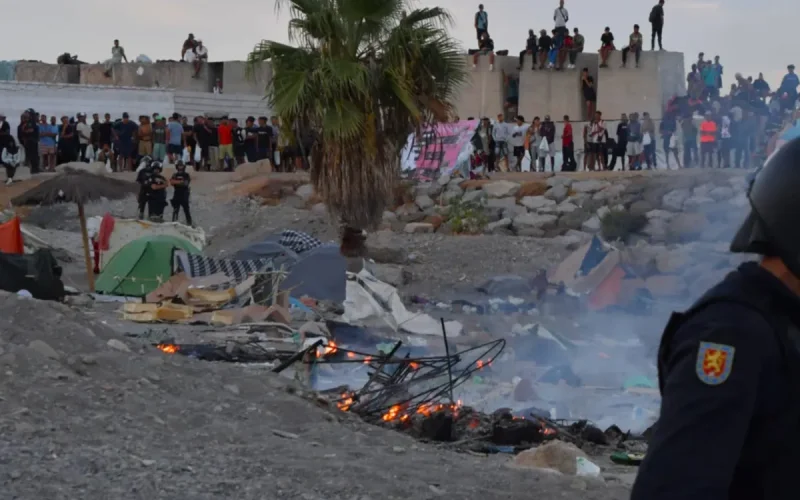
The European Commission wants to establish an exceptional mechanism allowing asylum procedures to be temporarily tightened and expulsions to be accelerated in the event of mass arrivals. The Ceuta crisis is intended to serve as a reference for this future system.
Ursula von der Leyen announced on Wednesday, September 16, the preparation of a new European emergency mechanism for borders facing exceptional migratory pressure. The president of the European Commission directly cited Ceuta, where the Spanish government’s initial estimates reported 49,000 arrivals from Morocco within a few hours.
“The border of Ceuta is a European border, and Europe will stand by you,” the leader declared before the European Parliament. Her plan should allow the states concerned to benefit from greater “flexibility” in applying European rules on asylum and returns.
According to information from Cadena SER, Brussels is considering, in particular, simplifying the processing of applications for international protection and shortening the deadlines required to carry out expulsions.
On Bladi.net : After 72,000 crossings from Morocco, Europe funds underwater drones in Sebta
This response would complement the financial resources already released by the European Union. Brussels has granted Spain 114.7 million euros to strengthen surveillance, reception capacity and facilities intended for returns following the mass crossings from Morocco.
A mechanism reserved for exceptional crises
The future mechanism would not automatically allow the right to asylum to be abolished. It would define the exceptional circumstances in which a state could temporarily derogate from ordinary procedures, particularly when mass arrivals are organized or used to destabilize an external border of the Union.
The precise arrangements remain to be developed. The Commission must still set the triggering criteria, the duration of the derogations and the safeguards applicable to people seeking international protection. The system will then have to go through the European legislative process before entering into force.
It therefore cannot be used immediately to expel all the people who arrived in Ceuta this summer. A large proportion of them have already returned to Morocco. The Spanish authorities are nevertheless continuing to identify and process several thousand cases, while the situation of minors remains particularly complex. Rabat says it wants to take them back, but Madrid criticizes it for not responding to the return requests already sent.
The European Parliament is due to vote this Thursday on a resolution devoted to the Ceuta crisis. This vote, separate from the future legislation announced by the Commission, is intended to clarify the political position of the European groups on strengthening the border, receiving migrants and accelerating returns.
On Bladi.net : Morocco Calls for the Return of Minors, Spain Accuses It of Failing to Respond to 600 Cases
With its future emergency framework, Brussels wants to prevent a new influx of a similar scale from leaving a member state to apply ordinary procedures for several weeks, procedures deemed too slow to register applications, identify people and organize their return.
Related Articles
-

Migrants: European Parliament wants to use funding and market access as leverage against Morocco
18 September 2026
-

Schengen visas: Brussels is preparing new rules that could change the situation for Moroccans
17 September 2026
-

A Four-Language Label Sends a Product from a Moroccan Manufacturer onto the Red List in the United States
17 September 2026
-

More than 43,000 military radios: the United States is preparing a new contract, and Morocco is already part of the arrangement
17 September 2026
-

A Former Account in Morocco and €6,000 from His Sons Cost Him Social Assistance… Until the Judge Intervened
17 September 2026